
MODERNA DIRECT
Redesigning invoicing and payments to recoup millions
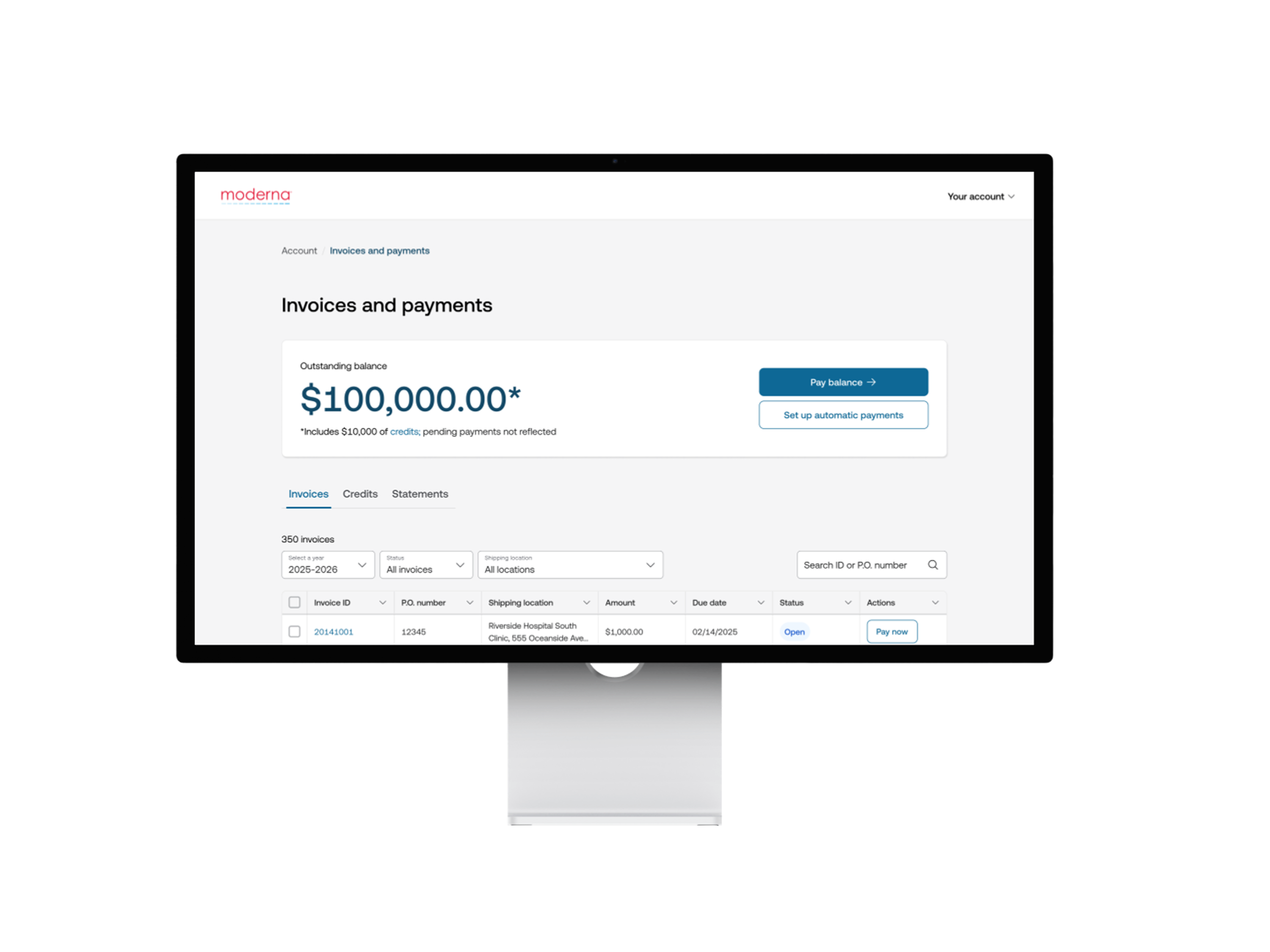

Overview
Moderna Direct had become a source of confusion and frustration for healthcare systems. In particular, customers couldn’t understand what they owed, orders were delayed, and teams spent weeks untangling billing and shipping errors. The platform was putting revenue, relationships, and trust at risk.
I led the redesign of Moderna Direct, focusing on the invoicing and payments experience. I architected clearer flows, detailed invoices, and new payment capabilities that reduced friction, restored trust, and helped the business recover significant revenue.
Role
Principal UX Designer
responsibilities
Redesign of Moderna’s eCommerce platform, focusing on the invoicing and payments and leading the shift from a B2C site to a B2B one
collaborators
Business, finance, account managers, data stewards, product manager, engineers
impact
Reduced outstanding balances by ~84%;
Transitioned site from B2C to a one that supports complex multi-site healthcare networks
The project
Customer problems
Customers couldn’t see what they owed or why. This caused delays, disputes, and a loss of trust.
IDNs lacked visibility into who ordered and who was responsible for payment, and invoicing emails often went to the wrong teams—creating confusion, delays, and unnecessary friction.
Business problems
Millions in revenue were tied up due to unclear invoices, manual reconciliation, and delayed payments.
Operational teams were overloaded, manually fixing billing errors, credit mismatches, and misrouted orders.
Risk of customers switching to Pfizer or 3rd party fulfillment options for a smoother billing experience.
Success metrics
Increase the number of invoices paid on time and accurately compared to the previous year
Decrease calls to the help center around billing and payment
Approach
Map the system to uncover root causes and dependencies
I began by clarifying our customers, business goals, and the realities of how large IDNs operate. I mapped the end-to-end journey across complex, multi-site relationships—spanning account managers, data stewards, procurement teams, and third-party fulfillment partners. Moderna Direct had been built for smaller organizations, and the current flows quickly revealed where it broke down for IDNs: layered roles, fragmented handoffs, and missing ownership signals.
By visualizing these workflows, I surfaced the dependencies and root causes behind their biggest frustrations—why customers couldn’t see who ordered what, who was responsible for paying, or how credits were being applied. The resulting system map became a shared source of truth for product, engineering, and business stakeholders, guiding decisions throughout the redesign.


Align the business through collaborative working sessions
I set up a series of structured working sessions with finance, operations, customer support, and account management to align on processes and decision points. These sessions helped us validate assumptions, expose conflicting workflows, and build shared ownership of the future-state experience. They also created a tighter feedback loop with the business, ensuring that every design decision was grounded in operational reality—not just customer need.
Use low-fidelity wireframes to clarify requirements and accelerate alignment
I introduced low-fidelity wireframes early to shift conversations from abstract problems to tangible workflows. These rough prototypes helped teams quickly validate what mattered, reconcile conflicting expectations, and uncover requirements that hadn’t surfaced before. For example, we learned that some large IDNs place up to 350 orders at once—driving the need for bulk invoice downloads, multi-invoice payment workflows, and updated customer email templates. The wireframes became a fast, low-risk way to test assumptions, pressure-test scale, and align stakeholders before committing to higher-fidelity design or engineering effort.

Driving cross-organizational alignment on pricing and language
I established an ongoing feedback loop with account managers and the finance team to validate details that materially impacted accuracy and trust. Together, we aligned on how pricing, credits, discounts, and line items should be structured, and we standardized the terminology used across teams. This continuous refinement ensured the experience reflected operational reality, reduced ambiguity for customers, and created a consistent language the entire organization could stand behind.

The solution
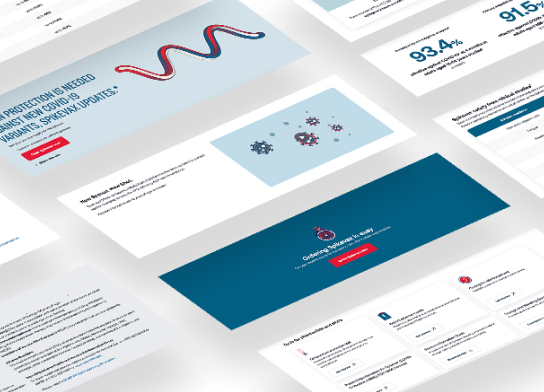
A few full-page views of the final experience (not inclusive).


“I’m obsessed with this new design. I want it right now.”
Caroline Lewis
Sr. Manager, Revenue & Collaboration
The business impact
~84%
Reduced outstanding balances
The redesign delivered meaningful business and customer impact across Moderna’s commercial ecosystem:
- Recovered millions in revenue by solving invoice confusion and fixing payment workflows—helping reduce outstanding balances from ~$60M to under $10M.
- Accelerated customer payments with ImmediatePay, AutoPay, and scheduled payments, replacing a fragmented GuestPay system with a streamlined logged-in experience.
- Lowered support volume by introducing accurate, line-item invoices, downloadable statements, and clearer pricing and discount structures.
- Reduced operational churn for finance, CX, and account management through Delegated Access and automated credit visibility.
- Enabled B2B scale by transitioning Moderna Direct from a B2C-oriented site to a platform capable of supporting large, multi-site healthcare systems and IDNs.


MODERNA DIRECT
Redesigning invoicing and payments to recoup millions
Overview
Moderna Direct had become a source of confusion and frustration for healthcare systems. In particular, customers couldn’t understand what they owed, orders were delayed, and teams spent weeks untangling billing and shipping errors. The platform was putting revenue, relationships, and trust at risk.
I led the redesign of Moderna Direct, focusing on the invoicing and payments experience. I architected clearer flows, detailed invoices, and new payment capabilities that reduced friction, restored trust, and helped the business recover significant revenue.
Role
Sr. UX Designer
responsibilities
Redesign of Moderna’s eCommerce platform, focusing on the invoicing and payments and leading the shift from a B2C site to a B2B one
collaborators
Business, finance, account managers, data stewards, product manager, engineers
impact
Reduced outstanding balances by ~84%;
Transitioned site from B2C to a one that supports complex multi-site healthcare networks
The project
Customer problems
Customers couldn’t see what they owed or why. This caused delays, disputes, and a loss of trust.
IDNs lacked visibility into who ordered and who was responsible for payment, and invoicing emails often went to the wrong teams—creating confusion, delays, and unnecessary friction.
Business problems
Millions in revenue were tied up due to unclear invoices, manual reconciliation, and delayed payments.
Operational teams were overloaded, manually fixing billing errors, credit mismatches, and misrouted orders.
Risk of customers switching to Pfizer or 3rd party fulfillment options for a smoother billing experience.
Success metrics
Increase the number of invoices paid on time and accurately compared to the previous year
Decrease calls to the help center around billing and payment
Map the system to uncover root causes and dependencies
I began by clarifying our customers, business goals, and the realities of how large IDNs operate. I mapped the end-to-end journey across complex, multi-site relationships—spanning account managers, data stewards, procurement teams, and third-party fulfillment partners. Moderna Direct had been built for smaller organizations, and the current flows quickly revealed where it broke down for IDNs: layered roles, fragmented handoffs, and missing ownership signals.
By visualizing these workflows, I surfaced the dependencies and root causes behind their biggest frustrations—why customers couldn’t see who ordered what, who was responsible for paying, or how credits were being applied. The resulting system map became a shared source of truth for product, engineering, and business stakeholders, guiding decisions throughout the redesign.
Approach
Align the business through collaborative working sessions
I set up a series of structured working sessions with finance, operations, customer support, and account management to align on processes and decision points. These sessions helped us validate assumptions, expose conflicting workflows, and build shared ownership of the future-state experience. They also created a tighter feedback loop with the business, ensuring that every design decision was grounded in operational reality—not just customer need.
Use low-fidelity wireframes to clarify requirements and accelerate alignment
I introduced low-fidelity wireframes early to shift conversations from abstract problems to tangible workflows. These rough prototypes helped teams quickly validate what mattered, reconcile conflicting expectations, and uncover requirements that hadn’t surfaced before. For example, we learned that some large IDNs place up to 350 orders at once—driving the need for bulk invoice downloads, multi-invoice payment workflows, and updated customer email templates. The wireframes became a fast, low-risk way to test assumptions, pressure-test scale, and align stakeholders before committing to higher-fidelity design or engineering effort.
Driving cross-organizational alignment on pricing and language
I established an ongoing feedback loop with account managers and the finance team to validate details that materially impacted accuracy and trust. Together, we aligned on how pricing, credits, discounts, and line items should be structured, and we standardized the terminology used across teams. This continuous refinement ensured the experience reflected operational reality, reduced ambiguity for customers, and created a consistent language the entire organization could stand behind.
The solution
A few full-page views of the final experience (not inclusive).
“I’m obsessed with this new design. I want it right now.”
– Caroline Lewis
Sr. Manager, Revenue & Collaboration
The business impact
~84%
Reduced outstanding balances
The redesign delivered meaningful business and customer impact across Moderna’s commercial ecosystem:
- Recovered millions in revenue by solving invoice confusion and fixing payment workflows—helping reduce outstanding balances from ~$60M to under $10M.
- Accelerated customer payments with ImmediatePay, AutoPay, and scheduled payments, replacing a fragmented GuestPay system with a streamlined logged-in experience.
- Lowered support volume by introducing accurate, line-item invoices, downloadable statements, and clearer pricing and discount structures.
- Reduced operational churn for finance, CX, and account management through Delegated Access and automated credit visibility.
- Enabled B2B scale by transitioning Moderna Direct from a B2C-oriented site to a platform capable of supporting large, multi-site healthcare systems and IDNs.
MODERNA DIRECT
Redesigning invoicing and payments to recoup millions
Overview
Moderna Direct had become a source of confusion and frustration for healthcare systems. In particular, customers couldn’t understand what they owed, orders were delayed, and teams spent weeks untangling billing and shipping errors. The platform was putting revenue, relationships, and trust at risk.
I led the redesign of Moderna Direct, focusing on the invoicing and payments experience. I architected clearer flows, detailed invoices, and new payment capabilities that reduced friction, restored trust, and helped the business recover significant revenue.
Role
Principal UX Designer
responsibilities
Redesign of Moderna’s eCommerce platform, focusing on the invoicing and payments and leading the shift from a B2C site to a B2B one
collaborators
Business, finance, account managers, data stewards, product manager, engineers
impact
Reduced outstanding balances by ~84%;
Transitioned site from B2C to a one that supports complex multi-site healthcare networks
The project
Customer problems
Customers couldn’t see what they owed or why. This caused delays, disputes, and a loss of trust.
IDNs lacked visibility into who ordered and who was responsible for payment, and invoicing emails often went to the wrong teams—creating confusion, delays, and unnecessary friction.
Business problems
Millions in revenue were tied up due to unclear invoices, manual reconciliation, and delayed payments.
Operational teams were overloaded, manually fixing billing errors, credit mismatches, and misrouted orders.
Risk of customers switching to Pfizer or 3rd party fulfillment options for a smoother billing experience.
Success metrics
Increase the number of invoices paid on time and accurately compared to the previous year.
Decrease calls to the help center around billing and payment.
Approach
Map the system to uncover root causes and dependencies
I began by clarifying our customers, business goals, and the realities of how large IDNs operate. I mapped the end-to-end journey across complex, multi-site relationships—spanning account managers, data stewards, procurement teams, and third-party fulfillment partners. Moderna Direct had been built for smaller organizations, and the current flows quickly revealed where it broke down for IDNs: layered roles, fragmented handoffs, and missing ownership signals.
By visualizing these workflows, I surfaced the dependencies and root causes behind their biggest frustrations—why customers couldn’t see who ordered what, who was responsible for paying, or how credits were being applied. The resulting system map became a shared source of truth for product, engineering, and business stakeholders, guiding decisions throughout the redesign.
Align the business through collaborative working sessions
I set up a series of structured working sessions with finance, operations, customer support, and account management to align on processes and decision points. These sessions helped us validate assumptions, expose conflicting workflows, and build shared ownership of the future-state experience. They also created a tighter feedback loop with the business, ensuring that every design decision was grounded in operational reality—not just customer need.
Use low-fidelity wireframes to clarify requirements and accelerate alignment
I introduced low-fidelity wireframes early to shift conversations from abstract problems to tangible workflows. These rough prototypes helped teams quickly validate what mattered, reconcile conflicting expectations, and uncover requirements that hadn’t surfaced before. For example, we learned that some large IDNs place up to 350 orders at once—driving the need for bulk invoice downloads, multi-invoice payment workflows, and updated customer email templates. The wireframes became a fast, low-risk way to test assumptions, pressure-test scale, and align stakeholders before committing to higher-fidelity design or engineering effort.
Driving cross-organizational alignment on pricing and language
I established an ongoing feedback loop with account managers and the finance team to validate details that materially impacted accuracy and trust. Together, we aligned on how pricing, credits, discounts, and line items should be structured, and we standardized the terminology used across teams. This continuous refinement ensured the experience reflected operational reality, reduced ambiguity for customers, and created a consistent language the entire organization could stand behind.
The solution
A few full-page views of the final experience (not inclusive).
“I’m obsessed with this new design. I want it right now.”
– Caroline Lewis
Sr. Manager, Revenue & Collaboration, Moderna
The business impact
~84%
Reduced outstanding balances
The redesign delivered meaningful business and customer impact across Moderna’s commercial ecosystem.
- Recovered millions in revenue by solving invoice confusion and fixing payment workflows—helping reduce outstanding balances from ~$60M to under $10M.
- Accelerated customer payments with ImmediatePay, AutoPay, and scheduled payments, replacing a fragmented GuestPay system with a streamlined logged-in experience.
- Lowered support volume by introducing accurate, line-item invoices, downloadable statements, and clearer pricing and discount structures.
- Reduced operational churn for finance, CX, and account management through Delegated Access and automated credit visibility.
- Enabled B2B scale by transitioning Moderna Direct from a B2C-oriented site to a platform capable of supporting large, multi-site healthcare systems and IDNs.